In my last post I talked mostly about the running experience, less on the specifics that helped me get across the finish line. Here I’ll go through some of my “must-haves” and tips. Again, I’m not a professional runner, just a person with a goal.
- BUY THE GOOD SHOES. I didn’t realize how important this was until I started getting some soreness in my Achilles tendon area and shins. I visited a local Fleet Feet to get fitted for my running shoes. At $175 they were a little spendy, but definitely worth it. I liked that an employee came over and focused his attention solely on me, learning what my running level and goals were, and what I liked and didn’t like. He then measured my feet, watched how my ankles/feet moved when I walked, and brought out a number of different shoes with different levels of cushion and support. It made me feel more confident in my purchase and helped me get the best shoe for my needs. I tried a few different pairs, but ultimately went with the Sauconys that had extra cushion and support (a little heavier shoe than I was used to, but I adjusted pretty quickly). In general, I recommend going to an actual running store and being fitted, if you’re going to spend the money you want to get the best shoes for your body and feet. I also recommend getting these a month+ before your race so they’re completely broke in.
- Get a watch that you can track your miles. Holy cow. My favorite thing ever is my Fitbit watch. I used mine nearly every workout, and loved knowing exactly what my pace and distance were. Not quite sure how I would have tackled my outdoor training without it.
- Visit your chiropractor (if you already use one). Not sure that I would recommend going to the chiropractor if you’ve never been, or if you don’t have any issues with your hips, back, or neck (what’s the old saying, don’t fix it if it ain’t broke?). But, I’ve always loved the chiropractor and feel like it really helps me (years of sports and a gnarly four wheeler wreck take their toll). For some reason it wasn’t until a fellow runner mentioned visiting their chiropractor that it dawned on me to go in. I’m glad I did, making sure my hips and back were in alignment was important, as running definitely takes a toll on your body. In general, this just goes back to taking care of yourself and making sure you’re supporting your body as it carries you through this journey.
- Even better, visit your masseuse. Massages are my number one way to relax, and I have a specific masseuse that I like to go to. She knows me, my body, and where I carry tension. I visited her a week or two before my race, and then the day after. Massages not only help me relax mentally, but they loosen and soothe my muscles, and help release any tension. Again, trying to take care of my body.
- Invest in some Epson salts. After long runs I looked forward to a relaxing bath with my Epson salts to help soothe my achy muscles. I think taking the time for a bath helps both your body and spirit. Your muscles can relax, and so can you.
- Vitamins! And I don’t just mean the Flinstones vitaminnies. When I was having a hard time with my energy levels and performance, my trainer recommended I take a look at my vitamins and to make sure I take them if I wasn’t already. I take two gummy multivitamin chews everyday, but also have some magnesium pills too. My trainer has a better vitamin game than I do, her’s consists of a specific set for am versus pm and in general is a little more detailed. She said it made a huge difference in how she felt and energy levels. There’s so much to learn in this department, and I look forward to doing more research into vitamins and their roles in performance and recovery (and uping my game here)!
- A proper, well-balanced diet, and don’t be afraid of those carbs. Carb is a naughty four letter word for some, but ensuring you’re replenishing your body and giving it enough fuel is critical. PS I also hate the word “diet”. Eat the good stuff, stay away from the junk, and be mindful about what you put into your body (the more unaltered foods the better). Be conscientious about how much you’re pulling from your body and what you’re asking your body to do. You don’t expect your car to take you across the country on one tank of gas. Unless maybe it’s a Tesla or Prius. But me, I’m more of a clunky ol’ Ford. Fuel me up. (Foods that helped keep me healthy and fueled while on the road and in the midst of a busy life – dried figs to curb my sweet tooth, RX bars, Larabars, unsalted roasted nuts, and I choose to drink Arbonne shake mix.)
- Pre-run food. This technically falls under #7, but I am going to elaborate here. I can’t run with a lot of food in my belly. My best runs were early in the day, and after I had just enough to keep my tummy calm, but not enough to slow me down. An RX bar and some water were my go-to. I also liked to add an Arbonne Fizz Stick to my water for a little extra natural energy. The night before my race I knew I wanted to be done eating before 7 pm so I had plenty of time to digest, and I wanted to eat foods that would theoretically stick to my hips (aka give me lasting energy to get across the finish line). I chose to eat a burrito with meat, beans, rice, and cheese. Plus some guac, salsa, and sour cream. Maybe stole some nachos and a couple bites of flautas, I don’t know, it may have happened. Deliciously. Anyway, it was a dense and filling meal, but it worked for me.
- Recovery routine. When I started getting into longer runs I noticed I was getting really lethargic and taking longer to recover. Which isn’t great news when you’re trying to stick to a schedule. After talking to some fellow runners, branched-chain amino-acids were suggested, as well as Beachbody Recovery Mix: https://www.beachbody.com/product/supplements/beachbody-performance/recover-post-workout-formula.do. I didn’t totally dive into the bcaa world, but did find that the Beachbody Recovery Mix not only tasted delicious (like a 50/50 bar) but also helped my body feel better faster. As important as your pre-run diet, is your post-run care. Find what you like and what works for you, your body will thank you.
- Get a big a$$ water bottle and glue it to your body. Not literally, that might be uncomfortable, but you get my point. I think everyone knows how important water is, but I wanted to emphasize it here. Especially the day before your race. I made sure I about drown my body with water the day before my race so I wouldn’t get as thirsty during the run. Seemed to work and I felt good. I also noticed when I was feeling tired or had a headache during my training, all I really needed was some extra water. In addition to water, to stay hydrated I also recommend taking a look at the Beachbody Hydrate product: https://www.beachbody.com/product/supplements/beachbody-performance/hydrate-during-workout-formula.do. I didn’t get it until the end of my training, so don’t have a lot of experience with it, but love the concept. You add it to your water, and it has carbs and electrolytes to keep you hydrated and replenished your body through your workout.
- Learn to enjoy rest days. In the beginning I had a really hard time being okay with rest days. I thought if I wanted to reach my goal I needed to be running and working out everyday, pushing my body to the limit. Realistically, sometimes the best thing you can do is get some extra sleep and let your body rest. Your body is amazing at telling you what it needs if you just listen.
- Running outfit. Yes I love shopping. When I decided to run, was I more excited about the prospect of a new outfit versus the running part? Yes. But on a serious note, being comfortable in what you run in is super important. Once we started to get out of winter and the cold, I noticed my legs would burn up if I wore long pants or even capri workout pants. And shorts, I hate feeling constrained when they don’t have give in the materia, but conversely hate when stuff rides up in, um, places it shouldn’tl. Luckily, I found some shorts at Wal-mart of all places. They split all the way up the side with spandex built into them. Coverage, flexibility, and total leg freedom. Perfect. (https://www.walmart.com/ip/5-Running-Short-with-Bike-Liner/515294009 ) Also, be aware of the anticipated conditions for your race. I knew it was going to be chilly, but wanted to wear my shorts, so also made sure to have a good hat, and a light, breathable sweater that I could tie around my waist when I got hot.
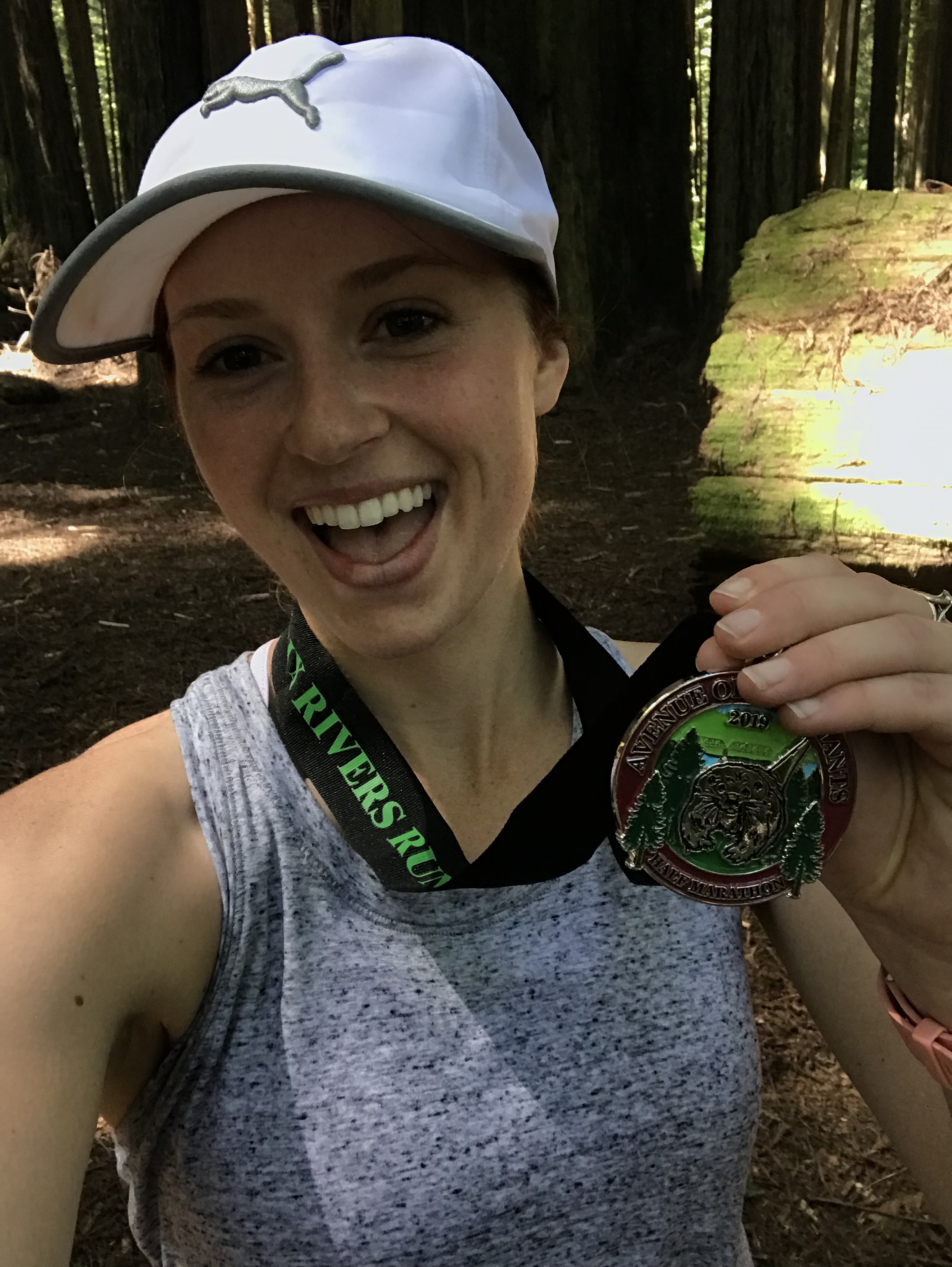
- Known your course and train specific to that. I obviously knew plenty about the Avenue of the Giants before running there, but I also read up on the website about the elevation and actual course. It was mostly flat, a few little rolling inclines here and there. Conveniently, there is a park about 500 feet from my house that has a track/path around it that is just over a quarter of a mile, paved, with some rolling inclines, and a water fountain. I used this park as I trained, figuring out my distances and paces, and stretch/water breaks. It helped me prepare for actual course conditions and accurately anticipate what it was going to be like. If you have the opportunity, I suggest getting a couple practices in an environment similar to your race course.
- Stretch it out. At every opportunity stretch. I even got one of those rollers that hurt like hell, but help massage out and stretch my muscles. I looked up new stretches, and tried to make stretching a priority. I wish I had done more of it, there’s always room for growth here!
- Most importantly, a positive mindset. As I mentioned in my first post about my run, overcoming the mental hurdles of running were the hardest part. Changing how you think and look at the situation, a good support system, clear goals, and a road map to get there, are all critical in positive thinking and success.

 Beer in a Martini World